New study maps the web of climate transition risks facing shipping and warns that siloed approaches to address them would not limit exposure
Research from Erasmus School of Law, University of Copenhagen and UCL provides the first integrated framework for understanding how climate-related transition risks cascade across maritime operations.
A new white paper published on 13 May 2026 argues that the sector's current fragmented approach to climate risk management leaves it dangerously exposed. The white paper titled, Navigating climate transition risks in global shipping, draws on a peer-reviewed academic study by researchers from Erasmus School of Law (including Jolien Kruit), University of Copenhagen and UCL, and provides comprehensive analysis of the climate-related transition risks facing the global shipping industry.
The study identified five interconnected categories of transition risk — litigation, policy, contractual, technology, and social, and maps the pathways through which risks in one domain can trigger or amplify consequences in another. For instance, the IMO's Carbon Intensity Indicator (CII) regulation requires investment in emissions-reducing technologies and operations, which in turn generates unresolved contractual questions around cost allocation and performance guarantees — questions that may ultimately land in litigation. Separately, social pressure for stronger environmental standards can accelerate regulatory ambition, while simultaneously triggering greenwashing claims and shareholder suits over inadequate climate disclosure.
With the IMO working towards the adoption of the Net Zero Framework later this year, EU ETS and FuelEU obligations already in force and other regional regulations forthcoming, the research argues that the shipping industry can no longer afford to treat legal, regulatory, contractual, technological, and social risks as separate business problems. The decisions companies make today — on fuels, contracts, financing, and fleet investment — will determine their exposure for decades. The central finding is action or inaction in a single risk category rarely stays contained.
The research draws on a mixed-methods approach combining a systematic literature review spanning the period 2014 to 2025 with legal doctrinal analysis of key maritime conventions, case law, and regulatory instruments. This dual approach allows the authors to connect insights from across disciplines and illustrate these through cascade chain examples. For example, the inclusion of shipping in the EU Emissions Trading System, for instance, introduces carbon pricing obligations that necessitate operational adjustments such as slow steaming or route optimisation, which in turn generate contractual uncertainties regarding cost allocation, performance obligations, and financial arrangements – issues that may ultimately give rise to disputes or litigation.
Understanding the interconnected nature of these risks and setting priorities accordingly will be essential for maintaining resilient and operationally sustainable maritime businesses as the sector accelerates its transition to decarbonisation.
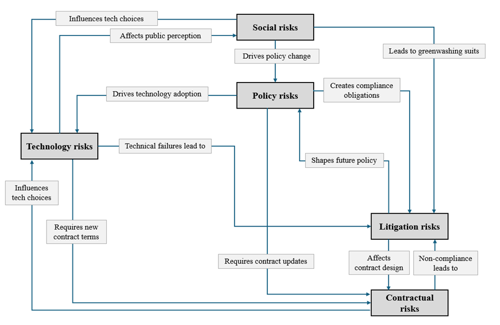
Interconnectedness of climate risks in the shipping industry
Hannah Mosmans, Stella Ebbersmeyer, Jolien Kruit, Beatriz Martinez Romera, Nishatabbas Rehmatulla & Marie Fricaudet
Link to white paper: https://www.shippingandoceans.com/post/new-study-maps-the-web-of-climate-transition-risks-facing-shipping
Link to full research paper: https://doi.org/10.1186/s41072-026-00233-7